PDF READ FREE China Rx: Exposing the Risks of America's Dependence on China for Medicine
[R.E.A.D] China Rx: Exposing the Risks of America's Dependence on China for Medicine EBOOK EPUB KINDLE PDF
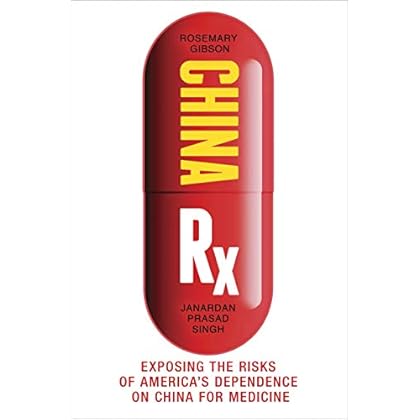
Description for China Rx: Exposing the Risks of America's Dependence on China for Medicine
Review �A must-read for everyone who takes, makes, regulates, or sells a prescription drug or an over-the-counter medicine. China Rx is a heroic and critical exploration into one of the greatest threats to both our national and health securities. China literally holds the health of much of the world in its business-driven hands. This is scarier than a Stephen King novel.� �Michael T. Osterholm, Regents Professor, University of Minnesota, and author of Deadliest Enemy: Our War against Killer Germs � 'In this alarming expos�, Gibson and Singh explain why the fact that the U.S. no longer makes penicillin and China supplies most of the ingredients in today�s prescription drugs is such a big problem and a threat to national security.... Readers will want to do more due diligence on the provenance of the drugs in their home medicine cabinets.'�Booklist�China Rx describes a major threat to the strategic position of the United States in the world, a matter affecting this country�s health and its economic and social well-being. This book reveals how the loss of the manufacturing capability and control of the supply of critical medicines, and their component ingredients, endangers the medical future of the American public while also posing a serious threat to our economy as well. The authors prescribe what must be done to remedy this major deficiency in our nation�s public health infrastructure.� �Edwin Meese III, 75th United States attorney general� �China Rx exposes the scary truth that a great number of prescription drugs and over-the-counter medicines in the United States have ingredients from China. There should be tougher import standards, a requirement for pharmaceutical companies to label a drug�s origins, and a reversal of US dependence on China.� �Jim Guest, former president, Consumer Reports�Everyone who has ever taken a pill needs to read this book. The American people won�t be happy when they find out that many of the medicines they rely on are being made in China where regulations aren�t enforced and/or documents are falsified.� �Leo W. Gerard, international president, United Steelworkers �Rosemary Gibson and Janardan Prasad Singh do an outstanding job of guiding the reader through the�inherent risk to the United States to become dependent on any one country, such as China, as a source for vital medicines, and the risks from weak enforcement of safety standards and quality control by�foreign�manufacturers.� �Maj. Gen. Larry J. Lust, US Army (ret.) �A compelling book that reveals America�s troubling dependence on China for essential medicines and the pattern in US-China trade where intellectual property and value-added production are shifted to China to the detriment of US workers, businesses, national security, and the health of our citizens.� �Daniel Slane, commissioner, US-China Economic and Security Review Commission ��A wake-up call for the public and policy makers to bring drug manufacturing home, safeguard American jobs, and strengthen national security.� �Scott N. Paul, president, Alliance for American Manufacturing�The authors tell how the institutions we trust have sold out to China and thrown American patients under the bus! As a quality professional, I am appalled that so many people care more about cost than the quality of our medicines. China Rx would make a great suspense thriller movie.� � �Martin VanTrieste, former chief quality officer, Amgen Read more About the Author Rosemary Gibson has been credited with creating national movements for safer, more humane health care. Her first book, Wall of Silence, with co-author Janardan Prasad Singh, put a human face on medical mistakes, launching a national campaign to improve the safety of America's health care. Gibson worked with Bill Moyers on the PBS documentary On Our Own Terms. She is a recipient of the Lifetime Achievement Award from the American Academy of Hospice and Palliative Medicine and is also the founding editor of a narrative series in the Journal of the American Medical Association (JAMA) Internal Medicine. She is senior advisor at the Hastings Center and the 2014 winner of the highest honor from the American Medical Writers Association. She is also the author, with Janardan P. Singh, of three other books on health care. ���� Janardan Prasad Singh is economic advisor at the World Bank. He designs strategies to strengthen economic development, health care, global trade, and national security for countries around the world. He has served as an advisor to prime ministers of India on national security affairs. Formerly, he was a member of the Board of Contributors of the Wall Street Journal. Read more Excerpt. � Reprinted by permission. All rights reserved. PrefaceIf you take a prescription drug, over-the-counter medicine, or vitamin, this book is for you. It reveals a dramatic shift in where the medicines�in your kitchen cabinet or desk at work are made. The mainstream media has virtually ignored this shift, and their silence has kept you in the dark.Antibiotics, chemotherapies, antidepressants, HIV/AIDS drugs, medicines for Alzheimer�s and Parkinson�s diseases, and birth control pills made in China are now sold in the United States. People taking them don�t know it, and neither do the physicians who prescribe them.China�s biggest footprint, though, is making the key ingredients in prescription drugs and over-the-counter products. It is the dominant world supplier of the essential ingredients needed to make thousands of medicines found in American homes and used in hospital intensive care units and operating rooms.�Why is this a problem? Because we trust blindly, unquestioningly, the purity of the medicine we take. We place medicine in our mouths, inject it, or wear patches so it seeps into our bloodstreams. Our medicine becomes a part of us. A poorly made athletic shoe is not a matter of life or death. But a poorly made drug could be the difference between life and death for those who take it. With medicine, there is no room for error. And it better be available when we need it.Worldwide dependence on a single country for life-saving medicines is breathtaking. �Without question, if China stopped exporting ingredients, within months the world�s pharmacies would be pretty empty,� says Guy Villax, chief executive officer of Hovione�, a Portuguese pharmaceutical company. Surgeries would be canceled, cancer treatments halted, kidney dialysis rationed. Infections would spread.China is the dominant global supplier of the essential ingredients to make penicillin. The United States doesn�t make penicillin anymore. The last penicillin fermentation plant phased out production in 2004. European and Indian plants have shuttered. When it comes to treating anthrax, �China is the largest exporter, head and shoulders above everybody else,� of the building block to make ciprofloxacin, an anthrax antidote, says Bharat Mehta, cofounder of PharmaCompass.com, the largest open-access global pharmaceutical database. Medicines manufactured in Canada, Europe, India, and other countries are made with active ingredients from China, and the finished drugs make their way to the United States and elsewhere. If a global shortage occurs, countries will queue up and compete for available supplies. Countries without strong safety rules are more at risk of buying contaminated and ineffective medicines.For an idea of how China might leverage our dependence, consider what happened in 2010 when China, the dominant global producer of rare earth metals, allegedly halted shipments to Japan. Toyota�, one of Japan�s biggest carmakers, depends on rare earth metals to make its popular hybrid cars. China reportedly didn�t end the embargo until Japan released the captain of a Chinese fishing boat that had collided with Japanese coast guard vessels in the East China Sea. The world can do without hybrid cars for a while, but in a public health emergency there is no time to wait for medicines.Despite the national security risk our dependence on China represents, US pharmaceutical companies have advocated for making it easier for the Department of Veterans Affairs to buy drugs made in China. Even now, if an altercation in the South China Sea causes Americans to be wounded, military doctors may have to rely on medicines with essential ingredients made by the adversary.China Rx is the story of America�s reliance on China for essential drugs, how the country became dependent, the risks of dependence,�and solutions to ensure self-sufficiency. We were inspired to write China Rx while in a Starbucks� two blocks from the White House, reading an online story in an Indian newspaper about India�s dependence on China for essential ingredients in antibiotics. India�s national security advisor warned of the risk of a severe shortage if any tension arises between the two countries.As we talked about whether America might also be dependent upon China, we saw a man sitting next to us popping a pill while sipping his coffee. We had seen him there before and knew he worked in the White House. We leaned over and asked him what he was taking. �An antibiotic for strep throat,� he replied. �What would you think if that pill was made in China?� we asked. He shook his head in disbelief, mumbling, �Is it safe?� We wanted to find the answer.We wrote this book because everyone affected by outsourcing decisions should be able to find out where his or her medicines come from, and if they are made to the highest standards.This book scratches the surface of a multibillion-dollar marketplace remarkable for its lack of transparency. We were able to piece together information from federal government documents, industry press releases, media reports, and scientific articles. Many people we interviewed are employed in the industry or government, and others are retired. Some understandably wish to remain anonymous, so we use pseudonyms for them.We wrote China Rx in the public interest, not for any special interest. It tells a human story of the impact of globalization and de facto deregulation of the safety and security of America�s medicines. We hope the book, with its landmark investigative research, increases public awareness about where America�s medicines come from and the risks.China Rx raises more questions than it answers. We invite policy makers, public interest organizations, and journalists to build on this foundation and delve deeper into the vast array of topics that we have only touched upon.When we mentioned to colleagues and friends that we were writing this book, one of the most frequent questions we heard was, �Why are we buying drugs from China? Can�t we make them here?� Others responded with resignation, saying, �Well, everything else comes from there.�Many companies say they are trying to reduce their exposure to foreign sourcing but can�t find products made in the United States. We have been heartened by a small number of industry players who want to ensure the country has a basic level of manufacturing capacity to make essential medicines. Jobs will return, communities will be revitalized, doctors and the public will have greater confidence in medicines, and the nation�s security will be strengthened.We hope China Rx stimulates public policies and private initiatives to achieve these noble aims. It won�t be easy, but with a spirit of optimism and determination, what seems impossible is possible. And it�s the right thing to do.Rosemary Gibson Janardan Prasad Singh Read more
Books are everywhere. Libraries big and small and bookstores are splattered all over college campuses and larger cities. They are all filled with one of the most important things of all time—books. Those who read books appreciate the multiple places to find books. Those who aren’t fans of books, don’t understand what could make readers want to obsess over books. There is a reason for their obsession, though. You hear it all the time: read every day.Reading is important because it develops our thoughts, gives us endless knowledge and lessons to read while keeping our minds active. Reading books to help us learn and understand and makes us smarter, not to mention the knowledge, vocabulary and thinking skills we develop.In the world today where information are abundant, reading books is one of the best ways to be informed. Though reading might seem like simple fun, it can be helping your body and mind without you even realising what is happening. What makes reading so important? It can be for these reasons and not just knowledge.For those who don’t enjoy it, you might change your mind after hearing about the benefits. Can something so easy and fun be so helpful in your life? Of course, it can! Reading can be a great benefit to you in many different ways—such as sharpening your mind, imagination, and writing skills. With so many advantages, it should be an everyday occurrence to read at least a little something.Books can hold and keep all kinds of information, stories, thoughts and feelings unlike anything else in this world. Can words, paragraphs, and fictional worlds be all that great for you and your health? It definitely can, and it is a timeless form of entertainment and information
Step-By Step To Download China Rx: Exposing the Risks of America's Dependence on China for Medicine
- Click The Button "DOWNLOAD" Or "READ ONLINE"
- Sign UP registration to access & UNLIMITED BOOKS
- DOWNLOAD as many books as you like (personal use)
- CANCEL the membership at ANY TIME if not satisfied
- Join Over 80.000 & Happy Readers.
OR

No comments :
Post a Comment