(READ) Serious Fun: How Guided Play Extends Children's Learning (Powerful Playful Learning)
[PDF] DOWNLOAD READ Serious Fun: How Guided Play Extends Children's Learning (Powerful Playful Learning) (PDF) Ebook
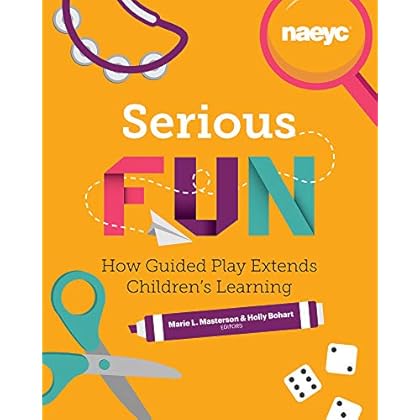
Description of Serious Fun: How Guided Play Extends Children's Learning (Powerful Playful Learning)
Review Serious fun: How guided play extends children�s learning provides many opportunities for the reader to consider important basic questions about the adult�s role in children�s play and the relations of teaching, playing, and learning with the focus on preschoolers and kindergartener. Many important forms of learning happen when intentional teaching is occurring, with play actions and thoughts of children one of multiple influences. Play is valuable, certainly, even when it does not contribute to the curriculum, and even if teachers are not involved. Nevertheless, this book draws attention to teacher (or parental) roles of providing background experiences, making play provisions, and implementing interactional strategies when these role responsibilities are directed to guiding the play of young children. Guided play is defined as the coming together of child-initiated play or exploration and adult guidance of the playing child in the service of developmental or educational aims, keeping in mind the importance of child autonomy and choice-making. The co-editors in their introduction offer as an advance organizer: Engage with the ideas presented throughout the book, considering children�s roles as active agents in their own learning and your own role in setting high expectations for children and helping them meet those expectations.Adult guided play needs to be examined in relation to other ways adults relate to children�s play. There is an important difference between adult-directed play and adult guided play, as well as between adult-child joint play (teacher as co-player/playmate, a rarity in school settings) and adult guided child play. Teacher observation and setting the stage for play distally and proximally (including making moment-to-moment situational adjustments) are constant, but whether adult�s interventions occur inside or outside the play frame varies. An extending style of adult guidance seeks to nurture ongoing play enactments preserving the play episode, but a redirecting style usually disrupts it. Co-editors Marie L. Masterson and Holly Bohart prepare the reader by noting,As you will see from the chapters in this book, there are a variety of ways to balance child initiation and choice with intentional adult scaffolding that adds to children�s present knowledge and abilities. Adult play guidance is multi-dimensional and can serve many purposes in early education as the text attractively and clearly illustrates. The volume is organized into two sections, Part One: Intentionally Creating Play Environments for Learning, and Part Two: Providing Rich Content Experiences Through Play. Part One�s two chapters are �Brain Science and Guided Play� by Brenna Hassinger-Das, Kathy Hirsh-Pasek, and Roberta Michnick Golinkoff, and �Observing, Planning, Guiding: How an Intentional Teacher Meets Standards Through Play� by Patricia McDonald. Part Two�s chapter three is entitled �Supporting Language Through Culturally Rich Dramatic Play� by Irasema Salinas-Gonzalez, Maria G. Arreguin-Anderson, and Iliana Alanis; chapter four �Connecting Art, Literacy, and Drama Through Storytelling�,Bonnie Ripstein; chapter five �Playful Math Instruction and Standards� by Deborah Stipek; chapter six � Fostering Positive Experiences in the Math Center for African American Boys� by Danielle. B. Davis and Dale C. Farran; chapter seven �What Can You Do with Bamboo? Preschoolers Explore a Natural Material: by Condie Collins Ward; and chapter eight � Engaging and Enriching Play is Rigorous Learning� by Shannon Riley-Ayers and Alexandra Figueras-Daniel. Support for playful learning coming from the sources this book cites which include the American Academy of Pediatrics Report on the power of play, NAEYC�s Position Statement on equity and diversity, and NAEYC Professional Standards and Competencies for Early Childhood Educators. The supporting research documentation for play overlaps with and is relevant to the book�s argument for guided playful learning. However, playful learning is not identical to adult guided playful learning. This review has already mentioned the fact that a great deal of what children learn in play can be without adults involved or any curriculum goals or learning standards in mind. Such play in general has been called authentic or everyday play, �real play�. Authentic play by definition is taken as meaningful to the child and is commonly considered as serving holistic development. Curricular play that children do is �polite play�, relationally motivated (based on the relationship the child has with his or her teacher). The teacher as an educational play curator has aims that may undermine the child�s play spirit or fabula �soul of play� (Lewis,2017). Hence the importance of learning how to be a good play teacher, one who knows how to read the child�s play state as well as the child�s sense of what the teacher is up to, empathy for the child�s empathy for the teacher�s perspective. Achieving and maintaining mutual engagement with one child is challenging, even greater this challenge when working with a small or large group of preschoolers or kindergarteners. Sensitive play guidance aiming to extend learning, enrich development or enhance the wellbeing of the child is easier said than done. It requires of the adult ability, skill and confidence to reach sustained intersubjectivity or reciprocity, shared thinking and actions (teacher-child and child-child) with children, within zones of proximal or dynamic development. The try for this is worth it, the pages of this book seem to whisper. Between the lines are sounds from voices past, Froebel�s play curriculum with his gifts and occupations, Maria Montessori�s Method and her pedagogical devises, sophisticated tools of play/work and learning, and John Dewey and the Progressives. A play-related educational concern of Dewey (1978) was that play requires adult guidance to serve an educational aim; purposeless play could end up being �arbitrary fancifulness�building up an imaginary world alongside the world of actual things� (p.308).The book is valuable for its special features as well as for its chapters. There are the wonderful photos and useful captions, thought-provoking questions and comments at the beginning of each chapter, and suggested strategies at the end of each chapter to use in one�s own teaching. Marie L. Masterson provides Reflection after chapter eight, which includes a useful �an environment for playful learning� checklist. Laurel Bongiorno writes at the end of the book a section for families �Play and Learning Go Hand in Hand�. Useful and up to date References and Resources for Further Learning close out this exciting and needed new book for teachers and parents of young children, also recommended for teacher educators and leaders. Dewey, J. (1978). How we think. In J. Boydston (Ed.), John Dewey: The middle works, 1899-1924, Volume 6: 1910-191 ( pp. 177-355). Carbonale, IL: Southern Illinois University Press. Lewis, P. (2017). The erosion of play. International Journal of Play, 6(1), 10-23. (James E. Johnson Teacher�s College Record) Read more About the Author Marie L. Masterson, PhD, is Director of Quality Assessment at McCormick Center forEarly Childhood Leadership, where she oversees evaluation for Illinois� quality rating and improvement system. Marie is an educational consultant to state departments of education, schools, child care centers, and social service and parenting organizations. She is a national speaker, child behavior expert, researcher, and author of multiple books and articles that address behavior guidance, early care and education, parenting, and high-quality teaching. Holly Bohart is senior editor in Books and Related Resources at NAEYC. She formerly taught in special education early childhood programs. Read more
Books are everywhere. Libraries big and small and bookstores are splattered all over college campuses and larger cities. They are all filled with one of the most important things of all time—books. Those who read books appreciate the multiple places to find books. Those who aren’t fans of books, don’t understand what could make readers want to obsess over books. There is a reason for their obsession, though. You hear it all the time: read every day.Reading is important because it develops our thoughts, gives us endless knowledge and lessons to read while keeping our minds active. Reading books to help us learn and understand and makes us smarter, not to mention the knowledge, vocabulary and thinking skills we develop.In the world today where information are abundant, reading books is one of the best ways to be informed. Though reading might seem like simple fun, it can be helping your body and mind without you even realising what is happening. What makes reading so important? It can be for these reasons and not just knowledge.For those who don’t enjoy it, you might change your mind after hearing about the benefits. Can something so easy and fun be so helpful in your life? Of course, it can! Reading can be a great benefit to you in many different ways—such as sharpening your mind, imagination, and writing skills. With so many advantages, it should be an everyday occurrence to read at least a little something.Books can hold and keep all kinds of information, stories, thoughts and feelings unlike anything else in this world. Can words, paragraphs, and fictional worlds be all that great for you and your health? It definitely can, and it is a timeless form of entertainment and information
Step-By Step To Download Serious Fun: How Guided Play Extends Children's Learning (Powerful Playful Learning)
- Click The Button "DOWNLOAD" Or "READ ONLINE"
- Sign UP registration to access & UNLIMITED BOOKS
- DOWNLOAD as many books as you like (personal use)
- CANCEL the membership at ANY TIME if not satisfied
- Join Over 80.000 & Happy Readers.
OR

No comments :
Post a Comment