PDF READ FREE Accounting for the Numberphobic: A Survival Guide for Small Business Owners
PDF READ FREE Accounting for the Numberphobic: A Survival Guide for Small Business Owners Online eBook
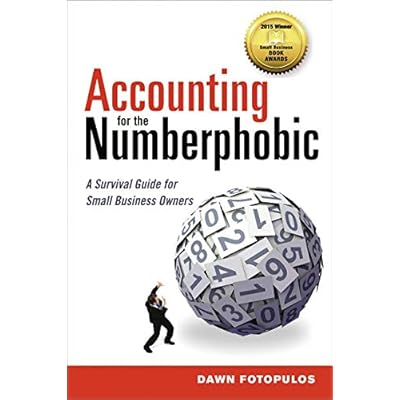
Description of Accounting for the Numberphobic: A Survival Guide for Small Business Owners
Review Insightly Best Small Business Books of 2014 ��.highly recommend the book to any small business owner, and it�s a great resource for any accountant who�s trying to explain accounting and financial statements to a non-accountant.� --Strategic Finance 'My copy is battered and torn, marked with post-its and scribbles....This should be a must read for every single business owner.' --Stephanie Burns/Chic CEO for Forbes Small Biz Trends Small Business Book Awards Economics 2015 Read more Book Description Why do so many business owners dread looking at the numbers? They make excuses�They don�t have time�That�s what the accountant is for....But the simple truth is that no one else will ever be as invested in their company as they are�and they need to take control. As a small-business owner, financial statements are your most important tools�and if you don�t know how to read them and understand their implications, you cannot possibly steer your business successfully. Accounting for the Numberphobic demystifies your company�s financial dashboard: the Net Income Statement, Cash Flow Statement, and Balance Sheet. The book explains in plain English how each measurement reflects the overall health of your business�and impacts your decisions. You will discover: How your Net Income Statement is the key to growing your profits � How to identify the break-even point that means your business is self-sustaining � Real-world advice on measuring and increasing cash flow � What the Balance Sheet reveals about your company�s worth � And more Illustrated with case studies and packed with practical action steps, this indispensable guide will put your business on the path to profitability in no time. Read more From the Back Cover If you're like many small business owners, the mere mention of the word 'accounting' fills you with the same sense of dread you had back in high school the night before a big math test. But your company may be at risk of failing, not due to the realities and challenges of the marketplace, but because you are uncomfortable reading and using basic financial measurements. However, never fear. By the time you've finished Accounting for the Numberphobic, you'll be reading your financial dashboard like a pro. This book takes the terror out of accounting, as it demystifies--in plain English--documents like the Net Income Statement, Cash Flow Statement, and Balance Sheet. Illustrated with real-world examples and packed with practical action steps, the book reveals: How your Net Income Statement is the key to growing your profits * How to identify the breakeven point that means your business is self-sustaining * What to do to measure and increase cash flow * What the Balance Sheet reveals about your company's worth * And much more As a business owner, you can't make responsible decisions if you don't understand the financial measurements that indicate the health of your business. This book takes the fear out of the numbers, and empowers you to steer your way straight toward profitability. Advance Praise for Accounting for the Numberphobic 'Anyone who runs or owns a small business should know what's in Accounting for the Numberphobic. If they're willing to learn what Dawn skillfully lays out in this book they will be more successful. Period.' -- Rich DeVos Sr., Cofounder of Amway and Senior Chairman of the NBA Orlando Magic 'If you are an artist and don't ever want the qualifier 'starving' in front of your title, make Dawn your guru and this book your guide.' -- Frances Pelzman Liscio, Founder, Punks and Roses.com DAWN FOTOPULOS is Founder of Best Small Biz Help.com, an award-winning blog and resource site for small businesses. A former banker, she is currently an Associate Professor of Business at The King's College in Manhattan. Twitter@BestBizHelp Facebook.com/BestSmallBizHelp Website: bestsmallbizhelp.com Read more About the Author DAWN FOTOPULOS is founder of Best Small Biz Help.com, an award-winning blog and resource site for small-businesspeople. A former banker, she is currently an Associate Professor of Business at The King's College in Manhattan. Read more Excerpt. � Reprinted by permission. All rights reserved. CHAPTER 1 Your Financial Dashboard The Net Income Statement, Cash Flow Statement, and Balance Sheet Accounting is a really big, complicated subject. It�s no surprise that many small business managers want to hand anything to do with numbers off to the �number people��CPAs, bookkeepers, bankers, and tax lawyers. Perhaps you can relate. If terms like GAAP accounting principles, tax legislation, debits and credits, and tax forms stress you out, don�t worry. First, you�re not alone. Second, this book is not going to cover these topics. It is, however, going to confront you with a truth you cannot afford to deny: If you want to be successful at managing a business, you need to become proficient at handling certain numbers. Put simply, you need to be able to read and understand your financial dashboard. Think about the dashboard in your car. You have a speedometer, a gas gauge, and an oil pressure gauge. These instruments measure the vital signs of your car�s operation. They give you critical information about how fast you�re moving, how much fuel you have in your tank, and the state of your engine. If any one of these instruments isn�t functioning or you don�t know how to read it, then pretty soon you�re going to be getting a ticket, stalling out, or blowing a gasket. Similarly, your financial dashboard has three gauges you need to be able to read to manage a business�your Net Income Statement, your Cash Flow Statement, and your Balance Sheet. These statements measure the vital signs of your business operations. They provide you with critical information about how much profit the business is generating, how much cash you have in the bank to run the business, and the overall health of the business at a point in time�information that allows you to make wise and timely decisions that will keep the business humming like a tuned-up car. And guess what? Your bookkeeper isn�t going to make those decisions for you. He�s there to make sure you have accurate and timely records of business transactions to send to your CPA. Your CPA is not going to make those decisions either. She is there to prepare your taxes and make sure you don�t get audited. It�s entirely possible for your �number people� to be doing their jobs superbly while you are steering your business into a financial danger zone. You could be spending money on the wrong things. As a business manager, you might be taking out crazy amounts of debt without understanding how fast that can sink the business. You are the one in the driver�s seat. And if you can�t read your financial dashboard, you�re driving with your eyes blindfolded. Unfortunately, this is exactly what over 85 percent of small business managers are doing, according to the U.S. Small Business Administration. It�s no wonder that 40 percent of these businesses fail to survive even four years. If you�ve heard this statistic, you�ve probably also heard the reasoning that it must be due to lack of start-up cash or unviable products and services. It�s not. There is plenty of cash available and broad enough markets for the business you manage to find new and loyal customers. Small businesses largely fail due to mismanagement. If you want to keep the business out of bankruptcy and reach the most important destination� sustainable profits and free cash flow�then you need to take the basic driving lessons necessary to maneuver a profit-making vehicle for the products or services you manage. You need to become fluent in reading what the financial dashboard reveals about your business. The great news is that you�re entirely capable of becoming an expert at this. How do I know? Because I�ve taught hundreds of small business managers�including the most extreme of number phobics�what I�m about to teach you. I�ve seen them grasp the concepts easily and, with many wonderful �aha!� moments, immediately begin to see exactly where the risks and opportunities are because they can finally understand how to respond to the numbers on their Net Income Statement, Cash Flow Statement, and Balance Sheet. My objective in this chapter is to expand your financial vocabulary beyond �bankruptcy� and �billionaire.� If you are like most small business managers, you may be familiar with some, if not most, of the financial terms in this book, but be at a total loss when it comes to grasping their meaning and real-world implications. This is like driving down the highway without being able to read the road signs. When you see a sign with the number �65� on it, there are several levels of knowledge you must have in order to read it. You need to know that it�s a speed limit, and that you�re expected to make sure the needle on your speedometer stays on or under a corresponding �65� mark. You also need to know what this sign implies: If you exceed this speed limit, you risk getting a speeding ticket. You may even lose your license if you test the limits too frequently. The numbers on your financial documents are like that speed limit sign. The sign doesn�t need to communicate everything� you�ve been taught what it means, and if you�ve been driving for a while, and especially if you�ve ever gotten a speeding ticket, then you know its implications. The sign is small, but the meaning is significant. The same is true of those little numbers on your financial dashboard. There are some nuances and calibrations to learn that are essential to you as you make day-to-day business decisions. So let�s start learning the lingo. I�m going to start by giving you a basic overview of these three financial documents and what they measure, along with a brief introduction to some of the implications these measurements have for managing your business. Let�s start with your speedometer�the Net Income Statement. THE NET INCOME STATEMENT The Net Income Statement, also known as the �Income Statement,� �Profit and Loss Statement,� and �P&L,� reveals whether a business is generating a profit, breaking even, or showing a loss. If you didn�t know that, don�t worry. Many small business managers don�t know it either. One small business manager who ran a series of salons for children attended one of my seminars. When I told her that all these terms mean exactly the same thing, she jumped up and said, �Are you kidding me? Is that what my accountant�s been talking about all these years?� Accountants might refer to the Net Income Statement as the �Income Statement,� typically dropping the qualifier �Net� because it�s implied and they assume you know that. And now you actually do. Similarly, the terms �net revenue� and �revenue� are used interchangeably. And sometimes you may see either �revenue� or �revenues� used as the plural form to describe the total amount of net sales. None of these terms should leave you in the cold. By the way, whenever you see the qualifier �gross��such as gross profits, gross receipts, or gross revenue�it means you�re looking at those numbers before expenses or discounts are deducted. Anytime you see the qualifier �net��as in net revenue, net expenses, or net income�it means you�re looking at the numbers after certain expenses have been accounted for. Armed with this simple knowledge, you�re already way ahead of the pack. Here are the key questions the Net Income Statement answers for you as a small business manager: � Is our business making any money? � Are our products and services the right ones? � Are we pricing our products and services so that we�re not cheating ourselves out of a reasonable return while still remaining an attractive alternative to the competition? � Is our gross margin robust enough to run the business? � Do we know what our true direct costs are? � How do we know our marketing efforts are paying off? � Do we have the right mix of clients? � How can we work half as hard and make twice the money? The Net Income Statement will reveal whether your business is generating a profit, breaking even, or losing money. If the number on the bottom line is positive, you�re making money. If it�s zero, you�re breaking even. If it�s negative, you�re losing money. The bottom line is what�s left after every direct and indirect expense is paid from net revenue. That number is why you�re in business. It�s net profit. Read more
Books are everywhere. Libraries big and small and bookstores are splattered all over college campuses and larger cities. They are all filled with one of the most important things of all time—books. Those who read books appreciate the multiple places to find books. Those who aren’t fans of books, don’t understand what could make readers want to obsess over books. There is a reason for their obsession, though. You hear it all the time: read every day.Reading is important because it develops our thoughts, gives us endless knowledge and lessons to read while keeping our minds active. Reading books to help us learn and understand and makes us smarter, not to mention the knowledge, vocabulary and thinking skills we develop.In the world today where information are abundant, reading books is one of the best ways to be informed. Though reading might seem like simple fun, it can be helping your body and mind without you even realising what is happening. What makes reading so important? It can be for these reasons and not just knowledge.For those who don’t enjoy it, you might change your mind after hearing about the benefits. Can something so easy and fun be so helpful in your life? Of course, it can! Reading can be a great benefit to you in many different ways—such as sharpening your mind, imagination, and writing skills. With so many advantages, it should be an everyday occurrence to read at least a little something.Books can hold and keep all kinds of information, stories, thoughts and feelings unlike anything else in this world. Can words, paragraphs, and fictional worlds be all that great for you and your health? It definitely can, and it is a timeless form of entertainment and information
Step-By Step To Download Accounting for the Numberphobic: A Survival Guide for Small Business Owners
- Click The Button "DOWNLOAD" Or "READ ONLINE"
- Sign UP registration to access & UNLIMITED BOOKS
- DOWNLOAD as many books as you like (personal use)
- CANCEL the membership at ANY TIME if not satisfied
- Join Over 80.000 & Happy Readers.
OR

No comments :
Post a Comment